
Microppose Sterile Petri Dishes 90mm | 20-Pack Sleeve
Microppose Sterile Petri Dishes 90mm | 20-Pack Sleeve is backordered and will ship as soon as it is back in stock.
Couldn't load pickup availability

Microppose Sterile Petri Dishes 90mm | 20-Pack Sleeve
Description
Description
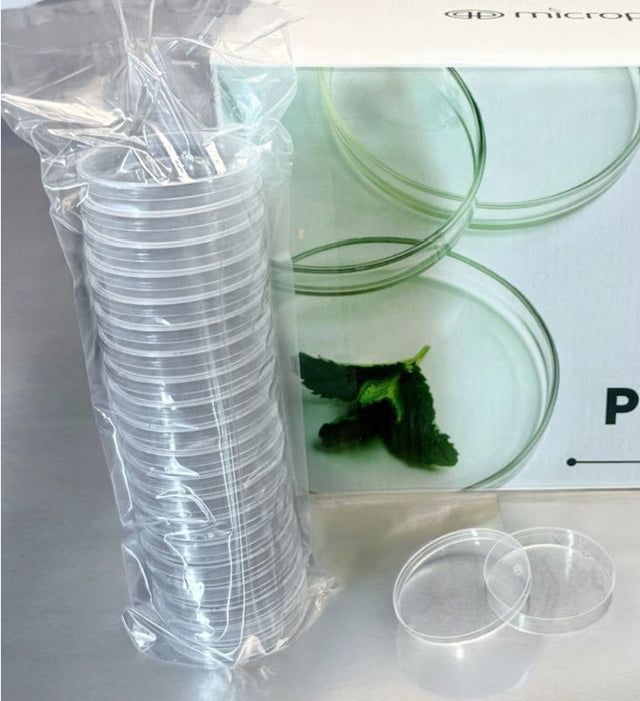
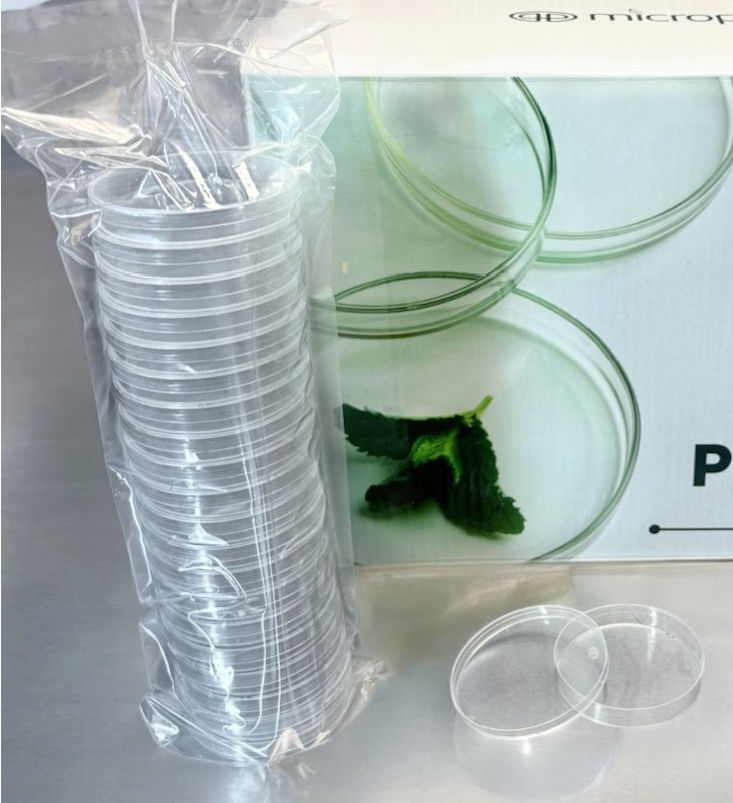
Microppose Sterile Petri Dishes — 20-pack sleeve of premium 90mm x 15mm polystyrene plates built for fast, clean culture work. Each dish arrives pre-sterilized from the factory in a sealed tear-away sleeve. Open it under your laminar flow hood or still-air box, pour your agar, and start working. No autoclave, no pressure cooker, no prep time.
Unlike reusable plates that need to be sterilized before each use, these come sterile from the factory. Perfect for first-time agar work, classroom projects, or any workflow where you don't have an autoclave or pressure cooker.
Why Choose Sterile Disposable Plates?
Disposable polystyrene petri dishes serve a fundamentally different use case than reusable plates — and there are several scenarios where they're the better choice:
- No autoclave required — opens up agar work to anyone who doesn't own a pressure cooker. Pour your prepared agar (after sterilizing it separately in a covered jar) directly into a freshly opened sterile dish.
- Superior optical clarity — polystyrene has crystal-clear glass-like transparency that polypropylene reusable plates can't quite match. For photographing cultures, evaluating subtle mycelium patterns, or showcase work, polystyrene wins on clarity.
- Zero cleaning cycle — when culture work is complete, discard the plate. No scrubbing, no rinsing, no second sterilization run. Saves time for high-volume workflows.
- Classroom-friendly — disposable plates are the standard for biology labs, microbiology courses, and educational settings where reusability isn't worth the staff time.
- Single-experiment workflows — for one-off cloning, occasional spore germination, or testing a specific strain, disposable plates are simpler.
Premium Microppose Construction
These aren't generic disposable plates — Microppose engineers their dishes meaningfully better than the cheap alternatives flooding the market:
- Optical-grade polystyrene for the clearest possible visibility of mycelium growth, contamination, and culture detail
- 16 grams per dish — 25% heavier than typical disposable plates, giving them better stack stability and reduced flex during transfer work
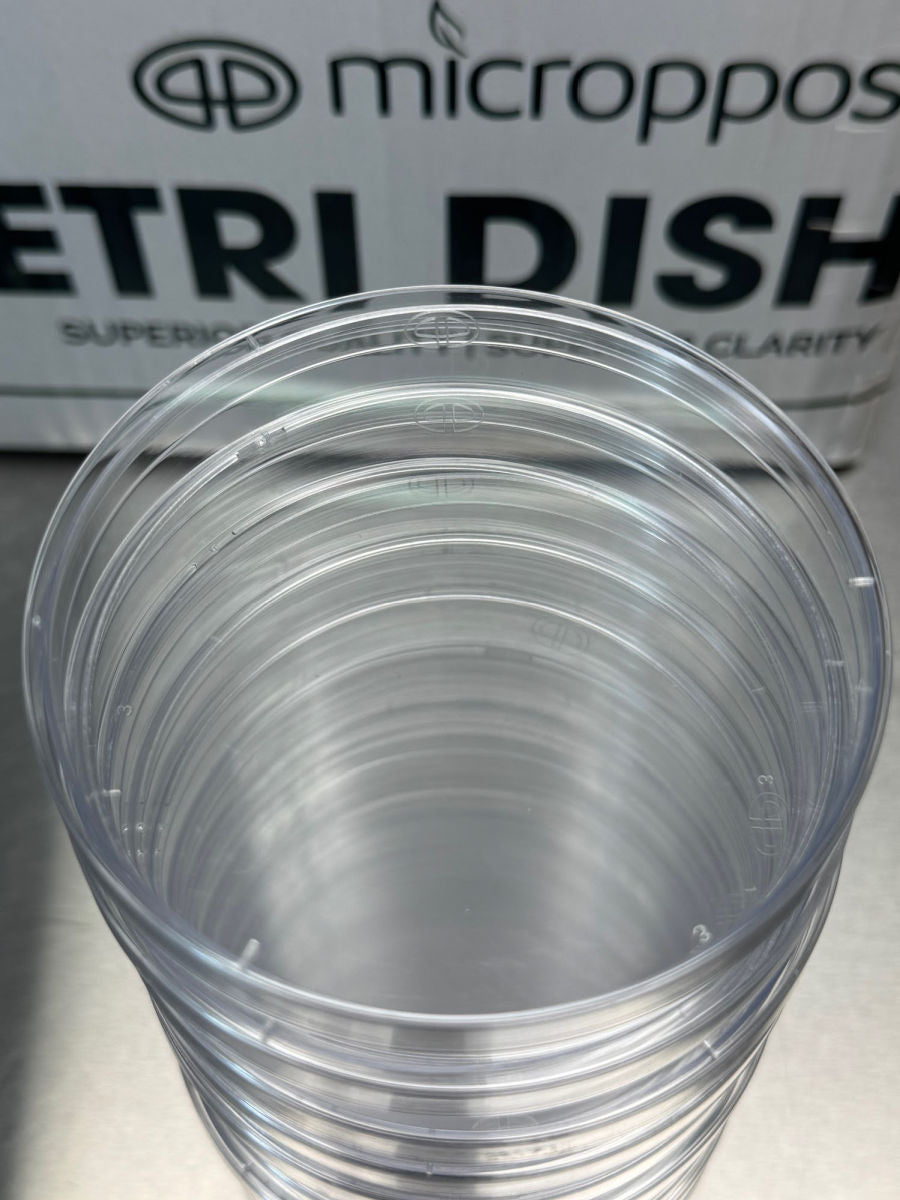
- Triple-vented lid design for balanced gas exchange during incubation — reduces excessive condensation buildup while maintaining a sterile barrier against airborne contaminants
- Flat-bottom design ensures even agar distribution when pouring — no thin spots or pooling that can affect mycelium growth uniformity
- Tear-away sterile sleeves keep plates sterile until the moment you need them; open one sleeve at a time to minimize wasted plates
Microppose products are designed in the USA and manufactured by one of the world's largest labware producers, combining global manufacturing scale with quality control standards used by professional laboratories.
What's in the Sleeve
- 20 sterile 90mm x 15mm Petri dishes in a single tear-away sleeve
- Polystyrene construction — single-use sterile plastic (NOT autoclavable, NOT for reuse)
- 16 grams per dish — 25% thicker than standard disposable plates
- Triple-vented precision-fit lids
- Factory pre-sterilized — sterile until the sleeve is opened
- Flat-bottom design for even agar pour distribution
- Brand: Microppose
How to Use
- Prepare your agar separately — mix your agar powder with distilled water in an autoclavable container, sterilize it in a pressure cooker at 15 PSI for 20 minutes, and let cool to 120–140°F (50–60°C). See our LME Agar Powder Blend for the recommended formulation.
- Open the sleeve under a flow hood — work in front of a laminar flow hood or inside a still-air box. Open the tear-away sleeve only when you're ready to pour.
- Pour — fill each dish about 1/3 full with cooled sterilized agar (roughly 18–20ml). Replace the lid immediately after each pour.
- Set — allow plates to solidify undisturbed for 30–45 minutes with lids slightly cracked to reduce condensation.
- Use or store — once solid, stack plates upside-down (lid on bottom) to prevent condensation drips. Use immediately, or store sealed (parafilm or saran wrap around the edge) in the refrigerator at 35–40°F for up to 30 days.
- Dispose after use — when culture work is complete, dispose of the plate. Do not autoclave polystyrene — it will warp and become unusable. For repeated use across many cycles, see our Microppose Reusable Autoclavable Petri Dishes.
New to agar work? See our Agar Basics tutorial.
Specifications
| Quantity | 20 dishes per sleeve |
| Dish dimensions | 90mm diameter × 15mm height |
| Weight per dish | 16 grams (25% heavier than standard disposables) |
| Material | Optical-grade polystyrene plastic (NOT autoclavable) |
| Use type | Single-use disposable — sterile from factory |
| Lid design | Triple-vented for balanced airflow |
| Bottom design | Flat-bottom for even agar distribution |
| Sterility | Factory pre-sterilized, sealed tear-away sleeve |
| Brand | Microppose |
Disposable vs. Reusable — Which Should You Choose?
We carry both formats because they serve different cultivators. Quick comparison:
| Choose Disposable (this product) | Choose Reusable Polypropylene |
| You don't own an autoclave or pressure cooker | You have a pressure cooker (15 PSI) or autoclave |
| You do occasional / one-off agar work | You do repeated, ongoing culture work |
| You want maximum optical clarity for photography | You want lowest long-term cost per plate |
| Classroom, single-experiment, or showcase use | Genetic library building, regular cloning, commercial use |
| Convenience is more important than cost-per-use | Sustainability and cost-per-use matter more than convenience |
Recommended Companion Products
- Myco Labs LME Agar Powder Blend — makes 200+ plates of premium MEA medium at ~$0.10 per plate
- Laminar Flow Hoods — for the cleanest pouring and transfer work
- Autoclaves & Pressure Cookers — for sterilizing your prepared agar before pouring
- Microppose Reusable Petri Dishes 90mm — autoclavable polypropylene for repeat use workflows
- Colonized Agar Plates — ready-to-use cultures for transfer to your fresh plates
- Agar Tools & Supplies — scalpels, parafilm, and other agar work accessories
Available in Bulk
Need more than 20? We also offer Microppose disposable petri dishes in a 500-pack case (25 sleeves of 20 plates) at significant volume savings — ideal for commercial labs, university classrooms, or anyone running high-volume culture work. Pallet pricing available for larger institutional orders; contact us for wholesale rates.
Frequently Asked Questions
Are these reusable? Can I autoclave them?
No — these are single-use disposable polystyrene plates. Polystyrene melts and warps at autoclave temperatures (121°C / 250°F), so attempting to sterilize them in a pressure cooker or autoclave will destroy them. For plates you can sterilize and reuse, see our Microppose Reusable Autoclavable Petri Dishes made from autoclavable polypropylene.
Do I need an autoclave to use these plates?
Not for the plates themselves — they arrive pre-sterilized from the factory. However, you do need a way to sterilize the agar medium before pouring it into the plates. This typically means a pressure cooker (any standard 23-quart canner that reaches 15 PSI works) or an autoclave. If you don't have either, you can purchase pre-poured agar plates that are ready to use without any sterilization equipment.
What's the difference between these and the reusable Microppose plates?
Three main differences. Material: These are polystyrene (single-use disposable); the reusable version is polypropylene (autoclavable). Optical clarity: Polystyrene has slightly better crystal-clear visibility; polypropylene is excellent but very slightly more opaque. Use case: Disposable is for one-time or occasional use; reusable is for ongoing repeat workflows where cost-per-plate drops dramatically over time. Both have the same dimensions (90mm x 15mm) and similar weight (16g vs 17g).
How long do the plates stay sterile in the sealed sleeve?
Indefinitely, as long as the sleeve seal remains intact. Microppose plates are factory-sterilized using gamma irradiation and sealed in nitrogen-flushed sleeves. Stored in a clean, dry place out of direct sunlight, unopened sleeves remain sterile for years. Once a sleeve is opened, plan to use the plates within a few days for best results — opened sleeves are no longer sterile barriers, even if you reseal them.
Why are these "triple-vented" lids and what does that do?
The triple-vented lid design has three small openings between the lid and dish base. This allows controlled gas exchange between the inside and outside of the dish during incubation, which prevents excessive condensation buildup on the lid (condensation can drip onto your culture and cause issues). At the same time, the vents maintain a sterile barrier against airborne contaminants — gases pass through, but contaminating spores and dust particles don't.
What kind of agar should I use with these?
For mushroom cultivation work, the standard formulation is malt extract agar (MEA) — sometimes called LME (light malt extract) when using the lighter grade. Our Myco Labs LME Agar Powder Blend is the pre-mixed formulation we use and recommend — one 200g bag makes enough agar to fill 200+ plates. For non-mycology applications, potato dextrose agar (PDA), nutrient agar, or specialty media work equally well.
How many plates does a 20-pack typically last for hobby use?
Depends on your workflow. A typical home cultivator working with 2–3 mushroom strains might use 5–10 plates per month for transfers, isolations, and genetic library maintenance — so a 20-pack lasts 2–4 months. For someone doing more intensive isolation work or working with many species, a 20-pack might be used in a few weeks. For high-volume or commercial work, the 500-pack case is the better choice.
Can I use these for non-mushroom applications?
Yes. These are standard laboratory-grade sterile petri dishes suitable for any application where 90mm pre-sterilized polystyrene plates are appropriate. Common non-mycology uses include cannabis tissue culture, plant tissue culture and micropropagation, bacterial and fungal culture in microbiology labs, classroom biology and life science labs, and DIY home lab projects. The factory sterility makes them especially convenient for educational settings where students wouldn't be running their own autoclave.
How should I dispose of used plates?
For home cultivators working with non-pathogenic species (gourmet and functional mushrooms), used plates can be discarded in regular trash after the agar is solidified — the polystyrene is not recyclable through most curbside programs due to contamination, so trash disposal is standard. For laboratory or classroom settings working with potentially hazardous microorganisms, follow your institution's biohazard disposal protocols (autoclave the plates first to kill any cultures, then dispose). Never compost used polystyrene plates.
Do you offer wholesale or bulk pricing?
Yes — for high-volume users, we offer Microppose disposable petri dishes in 500-pack cases at significant volume discount, and pallet wholesale pricing for institutional orders. Contact us for pallet quantities and freight pricing.
Let customers speak for us
I was getting alot of contam with northspore boomr bag strait garbage company. Contamination central at northspore almost everything contams. I tried a couple other companies then tried this blackcow. Its black gold Texas T the biggest dummy in the world will get massive flushes with this. The grain bags are awesome too and sterilized right. I went 14/14 on the grain bags. Midwest know what they are doing and even the packaging is next lvl everything double bagged. I only buy from midwest it's worth every cent

It's been several days since the Ecosphere arrived and I set it up, and I'm still amazed at all I got for the price: heater, fan, humidifier, two plug-in timers, two foil trays, and, of course, the five-tier tent with shelves and the plastic cover. Oh, and the LED light strip and the round air filters. It's everything I need right now, and I've started the growing process. It's a crazy good deal for the price. I'm new to mushroom growing, and I'm thrilled that I bought this setup as a start. Just plain wonderful.

Fast and easy colonization! These grain jars showed growth after just 10 days. My previous efforts with the all-in-one bags are taking MUCH longer but also working. Thank you Midwest Grow Kits 🙏

I love the people and the products. The people at MWGK clearly care about the integrity of the community they serve.

The monotub works amazing only had it a couple of weeks and about to have second harvest I used AIO grow bag for first flush and move to tub for second and its great not having to watch 24/7. Thanks Midwest

Four days after mixing grain, Select substrate, and the Midwest horse manure booster - the results speak for themselves.

It has everything you need for a fast, large flush success with fewer moving parts than a standard monotub. It is a surprisingly versatile option for more advanced students. Pic is 5 grain jar at 8 days. GT LM This is where I shop, now.

Rich, perfectly field-wet, sterile and it is perfect for those many varieties that won’t thrive quite as well in Bulk Substrate and Casing Mix, which I’ve seen as best for psilocybes/cyanescens. I’m using it for the first time with Lions Mane and King Trumpets. So far so good, 7 days and primordial and pins are starting to flourish. It drains better and is lighter than MGK’s Bulk Casing and Substrate. Great product.

Love the heater and how even and exact it heats. I set mine to 76 degrees and my room fluctuates from 64-75 and it holds solid at 75 degrees. I used a probe thermometer to double check the substrate level temp and its exactly 1 degree less than the heater setting. Another tip, I only needed to use the round monotub thermometer to check my humidity levels every so often. I would leave a filter disk on that hole instead of the thermometer. The only time it came in handy was after my first flush when humidity started to drop. I was able to use that gauge and check whether I needed to mist. Overall great kit and worth the money!

Ive bought mutiple jars before i came up with my own recipe, every jar produced healthy cultures, even if ones damaged in shipping they replace immediately, highly recommend

Very small chance that you get a contaminate you already had it and you’re either culture spores etc. their stuff is 100% sterile every time 100% of the time everything is viable never had a problem been shopping with them for sometime

It’s very good product and I highly recommend it to everyone.👏👏👏
I love my magnetic stir plate it works great for Liquid culture jars.

My bag had a slow start, but excellent finish. Oak Ridge.

Great product for my cannabis best deal around arrived fast thank you Midwest grow kits definitely will be purchasing again