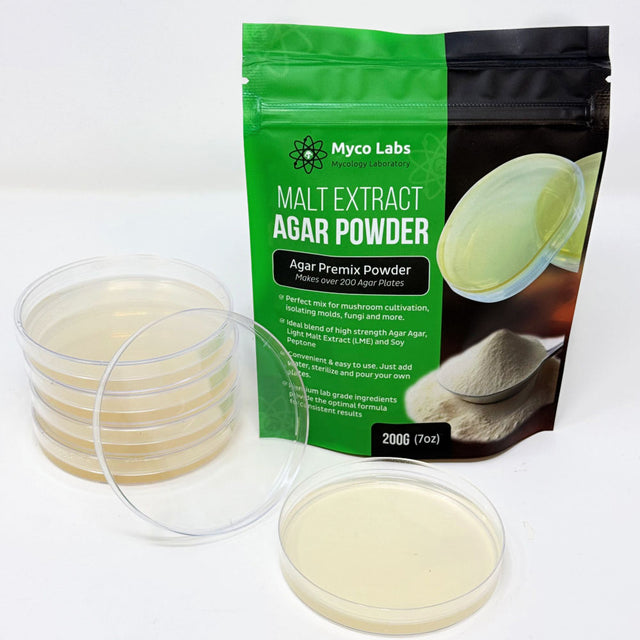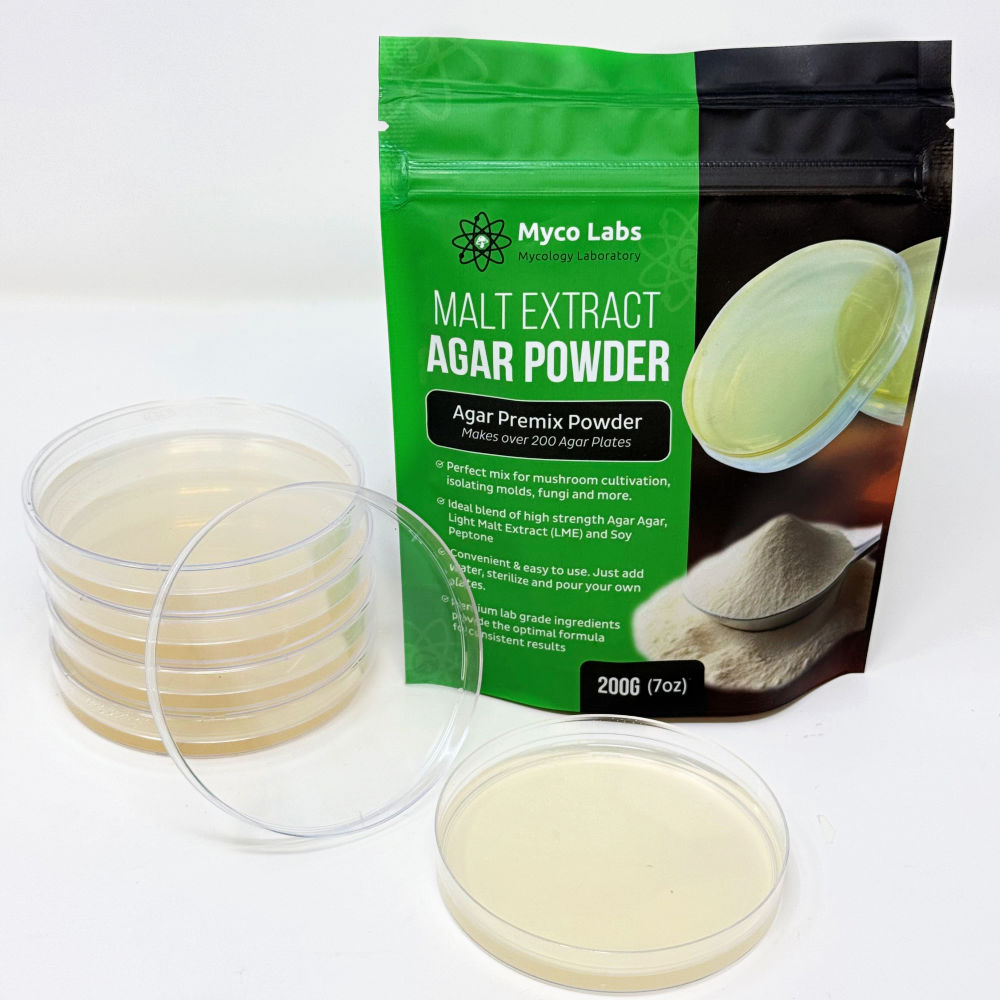
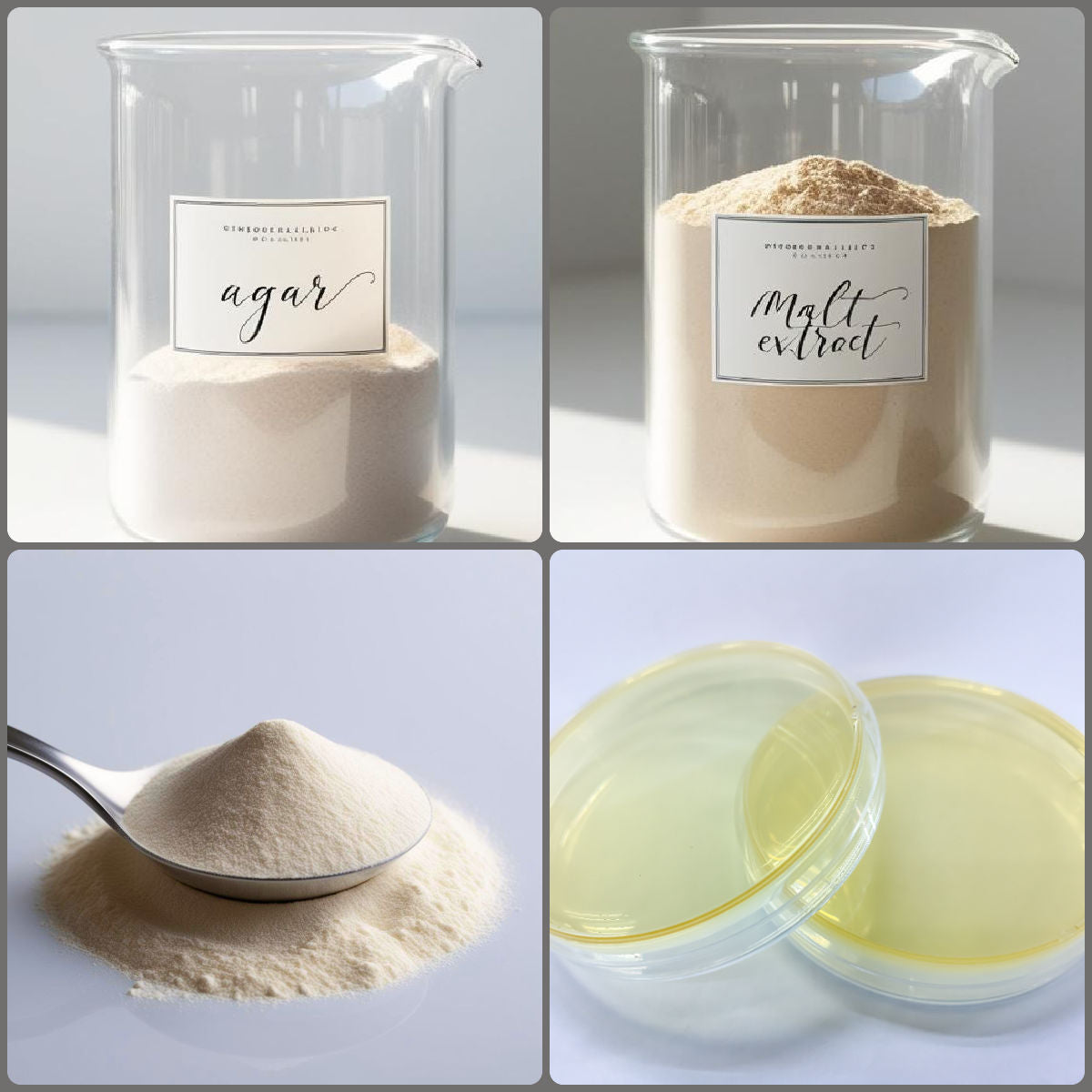
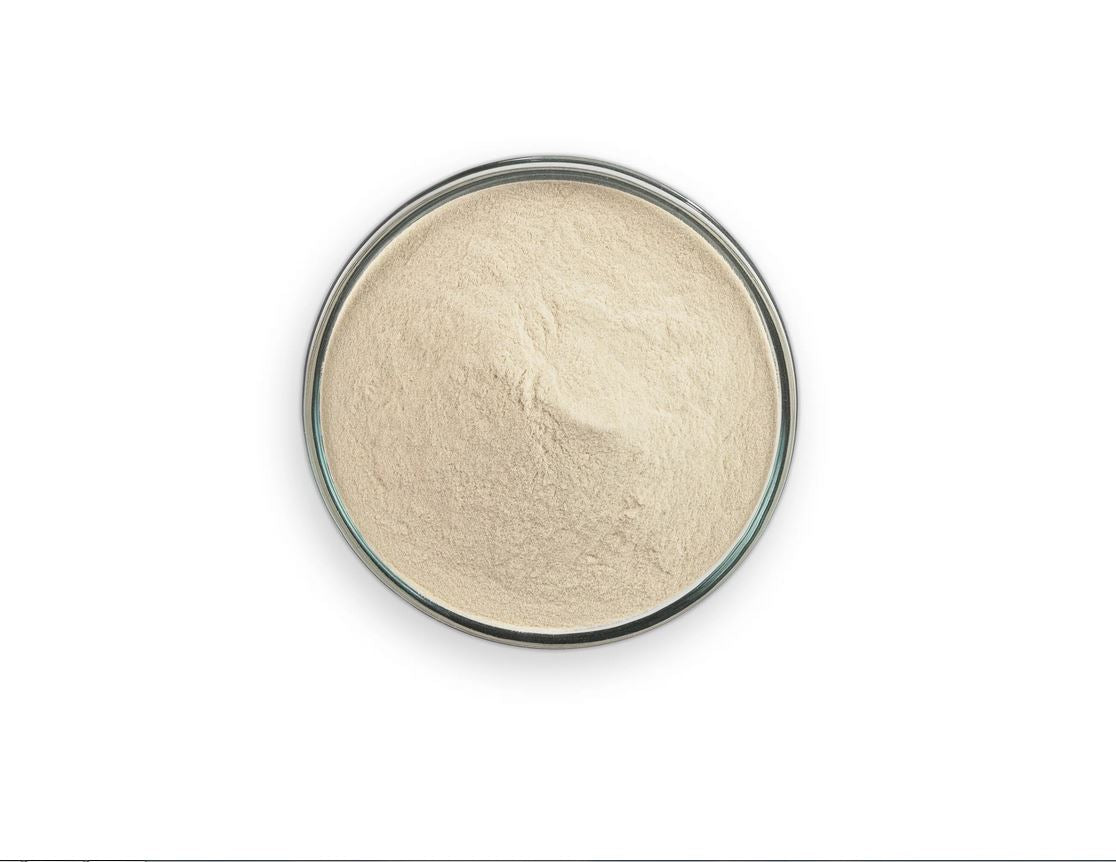
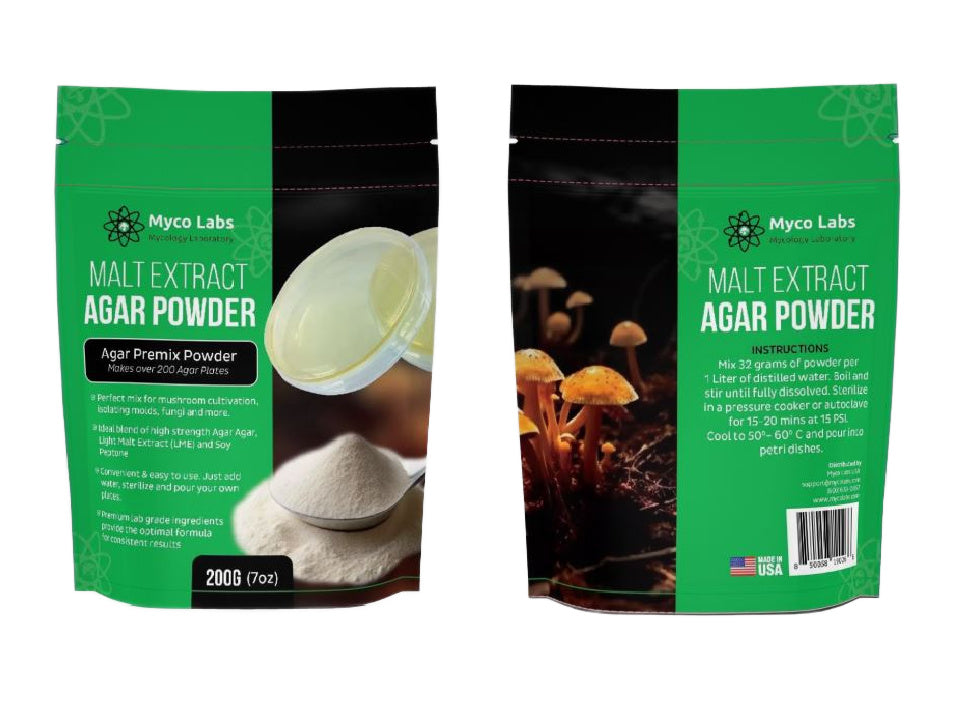
Myco Labs Light Malt Extract (LME) Agar Powder Blend - Makes 200+ Agar Plates 200g (7oz)
Myco Labs Light Malt Extract (LME) Agar Powder Blend - Makes 200+ Agar Plates 200g (7oz) is backordered and will ship as soon as it is back in stock.
Couldn't load pickup availability
Myco Labs Light Malt Extract (LME) Agar Powder Blend - Makes 200+ A...
Description
Description
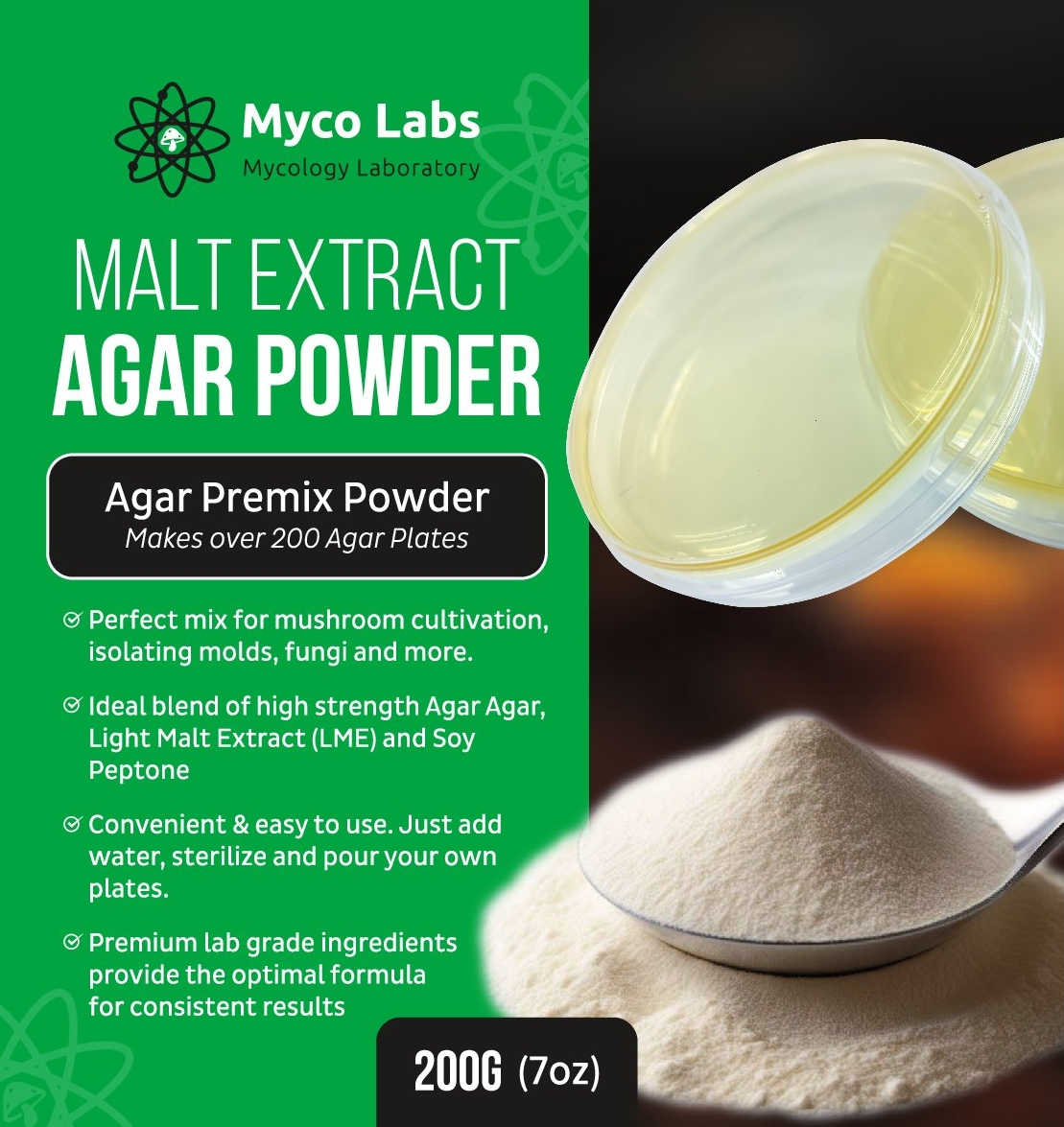
Myco Labs LME (Light Malt Extract) Agar Powder Blend is our premium house-formulated agar mix designed for mushroom cultivation, cloning, isolation work, and laboratory mycology. Each 200g (7oz) bag makes 200+ standard 90mm agar plates — the same formulation we use to pour our own colonized agar plates at the Myco Labs facility in Illinois.
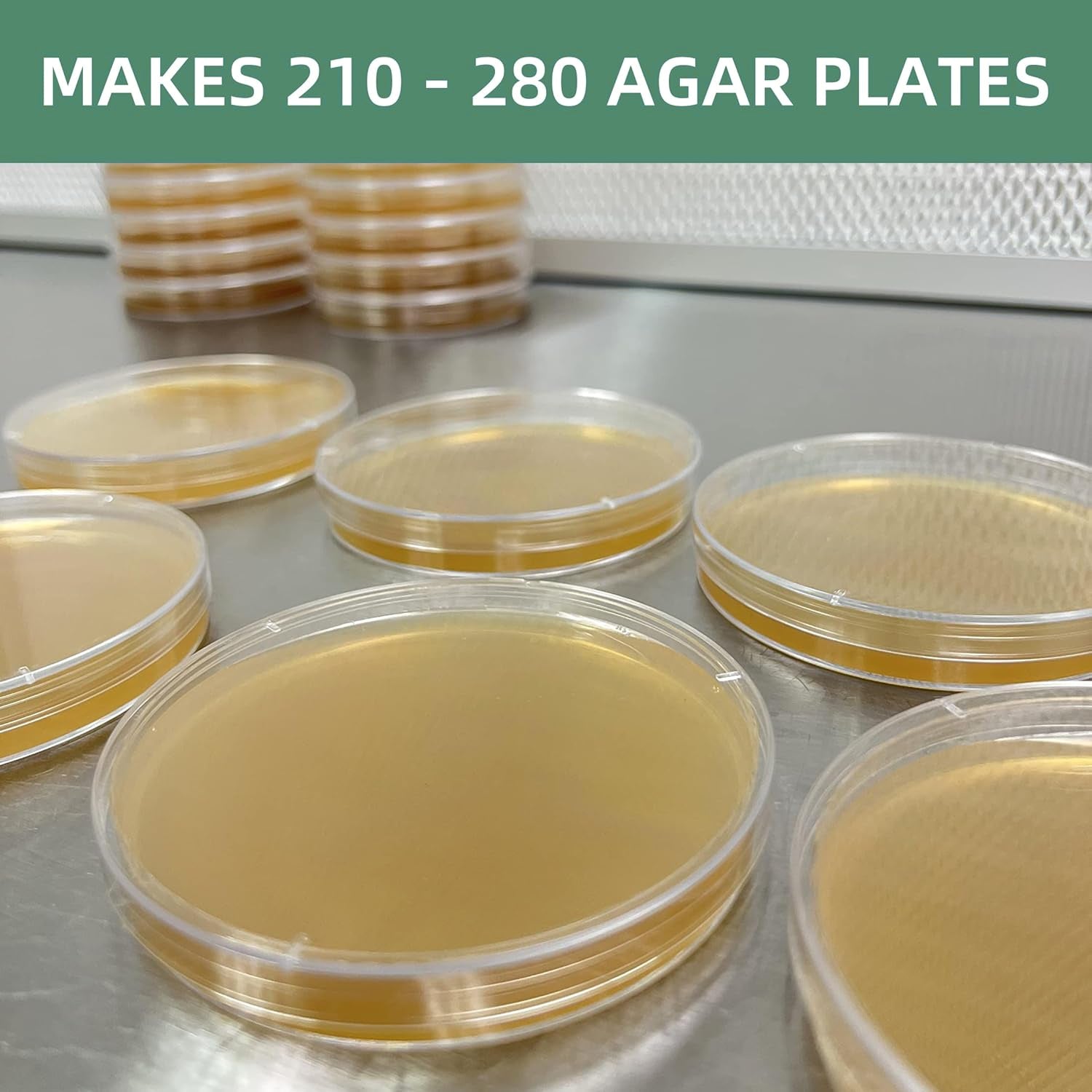
One 200g bag of LME powder + your own petri dishes and autoclave = roughly 200 plates at about 10 cents each. The same plate ready-poured from competitors typically costs $3–$5. The savings pay for an autoclave or pressure cooker within a few batches.
Why LME (Light Malt Extract)?
Light Malt Extract is the most versatile and widely-used base for mushroom agar work — and "LME" specifically refers to the lightest extract grade, which produces the cleanest amber-colored medium for evaluating mycelium growth visually. Compared to dark malt extract or generic "malt extract" mixes, LME offers:
- Better visual clarity — the lighter amber color makes contamination and mycelium growth easier to spot, especially valuable for sector isolation work
- Cleaner flavor profile in mycelium — for cultivators eventually fruiting from these cultures, lighter malts produce less off-flavor carryover
- Consistent nutrient density — light malt extract is more standardized across batches than darker variants, leading to more repeatable results across pours
- Broad species compatibility — works with virtually every gourmet, functional, and exotic mushroom species you'll encounter
The Myco Labs Formulation
Our blend combines three components in lab-tested ratios:
- Extra light malt extract — the primary carbohydrate and amino acid source, formulated for optimal mycelium nutrition without over-feeding
- High-strength agar powder — sets firm and clear, holds up under repeated transfer work, and resists tearing when you cut wedges for grain transfer
- Soy peptone — supplemental nitrogen source that supports robust mycelium development across a wide range of species, particularly important for slower-growing functional species like Reishi, Cordyceps, and Maitake
This is the same formulation we use to pour every colonized agar plate we sell — meaning when you use this powder, you're working with the proven recipe behind our commercial culture production.
What's in the Bag
- 200g (7oz) of pre-mixed LME agar powder
- Makes 200+ standard 90mm agar plates at the recommended 16g per 500ml water ratio
- Lab-grade ingredients sourced and blended at Myco Labs (Illinois, USA)
- Resealable bag for storage between uses
- 6-month shelf life once opened, when stored in a cool dry place
How to Use
- Measure — Use 16g of powder per 500ml of distilled water for standard agar plates. A 500ml batch produces approximately 25 plates at 18–20ml each.
- Dissolve — Mix the measured powder into distilled water in an autoclavable container (glass jar, Pyrex bottle, or autoclave-safe polypropylene). Stir thoroughly to break up clumps.
- Sterilize — Cover the container loosely (foil or vented cap) and sterilize at 15 PSI / 121°C for 20 minutes in a pressure cooker or autoclave. The agar must reach full sterilization temperature for the medium to set properly and remain sterile.
- Cool — Allow the sterilized agar to cool to approximately 120–140°F (50–60°C). At this temperature it's still liquid enough to pour but cool enough to handle safely. Too hot and it forms condensation; too cool and it sets in the bottle.
- Pour — Pour into sterile petri dishes in a laminar flow hood or still-air box. Fill each dish about 1/3 full (roughly 18–20ml). Allow plates to solidify with lids slightly cracked to reduce condensation.
- Store or use — Once solid, stack plates upside-down (lid on bottom) to prevent condensation drips onto the agar surface. Store sealed plates refrigerated at 35–40°F for up to 30 days before use, or use immediately.
New to agar work? See our Agar Basics tutorial for step-by-step pouring, inoculation, and transfer technique.
Specifications
| Net weight | 200g (7oz) |
| Plates per bag | 200+ standard 90mm plates (at 16g powder per 500ml water) |
| Cost per plate | ~$0.10 (vs. $3–$5 for pre-poured commercial plates) |
| Ingredients | Extra light malt extract, high-strength agar powder, soy peptone |
| Recommended ratio | 16g powder per 500ml distilled water (~25 plates per batch) |
| Sterilization | 15 PSI / 121°C for 20 minutes |
| Pour temperature | 120–140°F (50–60°C) |
| Shelf life (unopened) | 12+ months in cool dry storage |
| Shelf life (opened) | 6 months in resealed bag, cool dry storage |
| Brand | Myco Labs |
| Origin | Blended in Illinois, USA |
Pour Your Own with Microppose Reusable Petri Dishes
For the lowest possible cost-per-plate over time, pair this agar powder with our Microppose Reusable Autoclavable Petri Dishes. Reusable polypropylene dishes can be sterilized and reused dozens of times, dropping your effective long-term cost per plate to pennies. A 20-pack sleeve of reusable dishes + a 200g bag of LME powder is enough to do hundreds of plate cycles over the life of the dishes.
Recommended Companion Products
- Microppose Reusable Petri Dishes 90mm — autoclavable polypropylene, pours great with LME
- Laminar Flow Hoods — for the cleanest pouring and transfer work
- Autoclaves & Pressure Cookers — for sterilizing the prepared agar before pouring
- Colonized Agar Plates — ready-to-use cultures for transfer to your fresh plates
- Liquid Culture Syringes — alternative way to inoculate your poured plates
- Agar Tools & Supplies — scalpels, parafilm, and other accessories
Frequently Asked Questions
How many plates does one bag really make?
At the recommended 16g powder per 500ml water ratio, one 200g bag prepares enough medium for approximately 200 standard 90mm plates (filled to ~18–20ml each). In practice, most users get between 180–220 plates per bag depending on how much they fill each dish and how carefully they avoid spills. Either way, the cost per plate works out to approximately $0.10 — a fraction of the cost of pre-poured commercial plates.
What's the difference between LME, MEA, and other agar formulations?
LME stands for Light Malt Extract — it's a type of MEA (Malt Extract Agar) that specifically uses the lightest grade of malt extract. The terminology is sometimes used interchangeably, but technically MEA is the broader category and LME is a refined version. Compared to dark malt or generic "malt extract" mixes, LME produces a cleaner amber-colored medium that's better for visual evaluation of mycelium and contamination spotting. Our blend also adds soy peptone, which gives it stronger nitrogen content than basic MEA — beneficial for slower-growing species like Reishi, Cordyceps, and Maitake.
Can I use this for all mushroom species?
Yes. LME with soy peptone is the most versatile general-purpose agar formulation in mycology. It supports robust growth for all common gourmet species (oysters, Shiitake, Lion's Mane, King Oyster, Pioppino, etc.), functional species (Reishi, Cordyceps, Turkey Tail, Maitake, Chaga), and exotic varieties. For Lion's Mane specifically, you can add a small amount of food-grade activated carbon to create black agar for better mycelium visibility — though most cultivators find standard amber LME works fine for Lion's Mane too.
What kind of water should I use?
Distilled water is strongly recommended. Tap water contains minerals, chlorine, and chloramines that can affect agar set quality, alter pH, and in some cases inhibit mycelium growth. Distilled water is inexpensive (often $1–$2 per gallon at any grocery store) and ensures consistent, repeatable results. Reverse osmosis water also works well. Spring water is acceptable but less consistent batch-to-batch.
Do I need an autoclave, or will a pressure cooker work?
A standard kitchen pressure cooker that reaches 15 PSI works perfectly — you don't need a dedicated lab autoclave for hobby-scale agar work. Most cultivators use a 23-quart pressure canner from any kitchen supply store. The key requirement is reaching 15 PSI (which corresponds to 121°C / 250°F) for the full sterilization time. For larger-scale or commercial use, a dedicated autoclave makes the workflow faster and more reliable. See our Autoclaves & Pressure Cookers collection for options at every scale.
How long does prepared agar stay good once poured?
Sealed sterile plates (parafilm or saran wrap around the edge) stored refrigerated at 35–40°F stay viable for 30–60 days before use. At room temperature in a sealed bag, plates last roughly 2 weeks before drying out becomes noticeable. For long-term storage, refrigeration is essential. Note: refrigerated plates should be brought to room temperature before pouring agar into them or using them, to prevent condensation.
Why is my agar coming out cloudy instead of clear?
A few common causes: (1) the powder wasn't fully dissolved before sterilization — stir thoroughly until no clumps remain before autoclaving; (2) the agar was overheated during sterilization, which can cause caramelization — make sure your pressure cooker isn't running far over 15 PSI; (3) the water source contains minerals or contaminants — switch to distilled water; (4) you're using more powder than the recommended 16g per 500ml ratio. Our LME blend should produce a clear amber color when prepared correctly. Slight haziness is normal; significant cloudiness usually points to one of the above.
Is this the same agar you use in your colonized agar plates?
Yes. We pour every colonized agar plate sold on our site using this exact formulation. When you buy this powder, you're working with the proven blend behind our commercial culture production — the same recipe used to grow the Lion's Mane, Cordyceps Hades 4212-A, Shiitake 3790, Reishi, oysters, and other strains we sell as ready-to-use plates.
How should I store unused powder?
Reseal the bag tightly after each use and store in a cool, dry place — a kitchen pantry or cupboard is fine, no refrigeration needed. Avoid humidity and direct sunlight, which can degrade the malt extract over time. Properly stored, an opened bag stays fresh for 6 months. Unopened bags last 12+ months. The powder doesn't go "bad" so much as slowly lose nutritional potency, so older powder may produce slightly slower mycelium growth but won't cause contamination on its own.
Do you offer wholesale or bulk sizes?
Yes — for commercial cultivators, university labs, and high-volume users, we offer larger sizes and wholesale pricing on case quantities. Contact us for bulk pricing on 1kg+ orders.
Let customers speak for us
I was getting alot of contam with northspore boomr bag strait garbage company. Contamination central at northspore almost everything contams. I tried a couple other companies then tried this blackcow. Its black gold Texas T the biggest dummy in the world will get massive flushes with this. The grain bags are awesome too and sterilized right. I went 14/14 on the grain bags. Midwest know what they are doing and even the packaging is next lvl everything double bagged. I only buy from midwest it's worth every cent

It's been several days since the Ecosphere arrived and I set it up, and I'm still amazed at all I got for the price: heater, fan, humidifier, two plug-in timers, two foil trays, and, of course, the five-tier tent with shelves and the plastic cover. Oh, and the LED light strip and the round air filters. It's everything I need right now, and I've started the growing process. It's a crazy good deal for the price. I'm new to mushroom growing, and I'm thrilled that I bought this setup as a start. Just plain wonderful.

Fast and easy colonization! These grain jars showed growth after just 10 days. My previous efforts with the all-in-one bags are taking MUCH longer but also working. Thank you Midwest Grow Kits 🙏

I love the people and the products. The people at MWGK clearly care about the integrity of the community they serve.

The monotub works amazing only had it a couple of weeks and about to have second harvest I used AIO grow bag for first flush and move to tub for second and its great not having to watch 24/7. Thanks Midwest

Four days after mixing grain, Select substrate, and the Midwest horse manure booster - the results speak for themselves.

It has everything you need for a fast, large flush success with fewer moving parts than a standard monotub. It is a surprisingly versatile option for more advanced students. Pic is 5 grain jar at 8 days. GT LM This is where I shop, now.

Rich, perfectly field-wet, sterile and it is perfect for those many varieties that won’t thrive quite as well in Bulk Substrate and Casing Mix, which I’ve seen as best for psilocybes/cyanescens. I’m using it for the first time with Lions Mane and King Trumpets. So far so good, 7 days and primordial and pins are starting to flourish. It drains better and is lighter than MGK’s Bulk Casing and Substrate. Great product.

Love the heater and how even and exact it heats. I set mine to 76 degrees and my room fluctuates from 64-75 and it holds solid at 75 degrees. I used a probe thermometer to double check the substrate level temp and its exactly 1 degree less than the heater setting. Another tip, I only needed to use the round monotub thermometer to check my humidity levels every so often. I would leave a filter disk on that hole instead of the thermometer. The only time it came in handy was after my first flush when humidity started to drop. I was able to use that gauge and check whether I needed to mist. Overall great kit and worth the money!

Ive bought mutiple jars before i came up with my own recipe, every jar produced healthy cultures, even if ones damaged in shipping they replace immediately, highly recommend

Very small chance that you get a contaminate you already had it and you’re either culture spores etc. their stuff is 100% sterile every time 100% of the time everything is viable never had a problem been shopping with them for sometime

It’s very good product and I highly recommend it to everyone.👏👏👏
I love my magnetic stir plate it works great for Liquid culture jars.

My bag had a slow start, but excellent finish. Oak Ridge.

Great product for my cannabis best deal around arrived fast thank you Midwest grow kits definitely will be purchasing again