
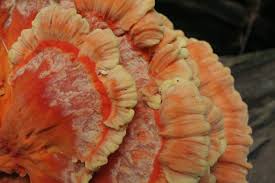
Chicken of the Woods Liquid Culture Syringe (10cc)
Chicken of the Woods Liquid Culture Syringe (10cc) is backordered and will ship as soon as it is back in stock.
Couldn't load pickup availability
Description
Description
Chicken of the Woods Liquid Culture Syringe (10cc) — Laetiporus spp., first-generation (G1) isolated genetics from Myco Labs. This is the sulfur-yellow shelf fungus that foragers hunt for: overlapping tiers of bright orange and yellow flesh with a dense, fibrous texture that genuinely does resemble chicken breast when cooked young.
- GenusLaetiporus
- Volume10cc
- GeneticsG1 Isolated
- DifficultyIntermediate
- Colonization~18 Days
Why Growers Choose Chicken of the Woods
Nothing else in this catalog looks like it. Chicken of the Woods forms broad overlapping brackets in sulfur-yellow through vivid orange, and a good flush is genuinely startling to look at. It is one of the most recognizable fungi in North America, which is part of why growers want it at home rather than waiting to stumble on one in the woods.
The eating quality is the other half. Harvested young, the flesh is dense and fibrous with a texture closer to poultry than to any gilled mushroom — some people read it as chicken, others as lobster or crab. It takes well to pan-frying, grilling and breading, and it is one of the few mushrooms that genuinely works as a whole-cut meat substitute rather than as a mushroom in a dish.
Timing is the skill here. Young brackets are tender and excellent; older ones turn woody, chalky and sour at the edges. Cut them while the margins are still soft and the colour is bright.
What's In the Package
- One 10cc liquid culture syringe, sealed and lab-tested
- 16-gauge 1.5" luer lock needle
- Sterile alcohol prep pad
Chicken of the Woods Growing Specifications
| Specification | Details |
|---|---|
| Scientific Name | Laetiporus spp. |
| Also Known As | Chicken of the Woods, sulphur shelf, chicken fungus |
| Recommended Substrates | Rye berries for spawn; supplemented hardwood sawdust or straw for bulk |
| Incubation Temperature | 68–80°F |
| Incubation Humidity | 85–90% |
| Colonization Time | ~18 days |
| Fruiting Temperature | 67–76°F |
| Fruiting Humidity | 90–93% |
| Time to Harvest | 20–30 days after fruiting conditions begin |
| Harvest Window | Young and tender — older brackets turn woody and sour |
| Preparation | Always cook thoroughly; never eat raw |
| Storage | Refrigerate syringe at 35–45°F; do not freeze |
How to Use Your Liquid Culture Syringe
- Let the syringe come to room temperature, then shake gently to redistribute the mycelium evenly through the broth.
- Flame-sterilize the needle until it glows orange and let it cool for a few seconds.
- Wipe the injection port on your rye berry spawn bag or jar with the alcohol prep pad.
- Inject 2–3cc per quart jar, or 3–5cc per 3–5 lb spawn bag. One 10cc syringe inoculates roughly 2–4 containers.
- Incubate at 68–80°F in the dark for around eighteen days until fully colonized.
- Spawn to supplemented hardwood sawdust and fruit at 67–76°F with high humidity. Expect twenty to thirty days.
Frequently Asked Questions
Does Chicken of the Woods really taste like chicken?
Closer than any other mushroom does. Harvested young, the flesh is dense and fibrous and pulls apart in strands rather than slicing like a cap mushroom — most people read it as chicken breast, though some taste lobster or crab instead. It breads and fries well and holds together as a whole cut, which is why it is a favourite meat substitute.
When should I harvest?
Early. Young brackets with soft, rounded margins and bright colour are tender and mild. Once the shelves mature they turn woody and chalky toward the base and can develop a sour taste, and no amount of cooking recovers that. If you are unsure, cut sooner rather than later and take the outer edges.
Does it need to be cooked?
Always, and thoroughly. Chicken of the Woods should never be eaten raw or lightly cooked. It is also worth knowing that a minority of people experience digestive upset from this species even when it is correctly identified and properly cooked, so if you have not eaten it before, try a small portion first and wait a day before making a meal of it.
What substrate should I use?
Rye berries make good spawn, and supplemented hardwood sawdust is the best bulk substrate — this is a hardwood-decay bracket fungus that grows on standing and fallen trees in the wild. Straw will work but produces smaller, less substantial brackets than a wood-based mix.
How much liquid culture do I use per bag or jar?
Use 2–3cc per quart grain jar and 3–5cc per 3–5 lb spawn bag. A single 10cc syringe will inoculate roughly two to four containers. Adding more than the recommended dose does not speed colonization meaningfully and simply uses up the syringe faster.
Do I need a flow hood or still air box to use liquid culture?
A still air box is strongly recommended and a laminar flow hood is better still. Liquid culture syringes ship sealed and lab-tested, but the moment you pierce an injection port you are exposing your grain to whatever is in the room air. Working in still air with flame-sterilized tools dramatically improves your success rate.
How should I store the syringe before use?
Keep it refrigerated between 35 and 45°F and never freeze it — freezing ruptures the cell walls and kills the culture. Store it in the sealed bag it shipped in, away from strong odors. Bring it back to room temperature and shake gently before injecting.
Packed to Arrive Alive
A liquid culture syringe is living mycelium, and the trip from our Illinois lab to your door is the part of its life you have the least control over. That is why every Myco Labs liquid culture ships inside a foil-lined insulated mailer rather than a plain envelope. The insulation buffers the syringe against summer heat sitting in a delivery truck and against sub-freezing temperatures in winter, so your culture arrives viable in either extreme.

When it arrives: move the syringe to the refrigerator at 35–45°F until you are ready to inoculate. Never freeze it. Bring it back to room temperature and shake gently before use.
Our Growing Experts Recommend
Products our growers commonly use with this item

