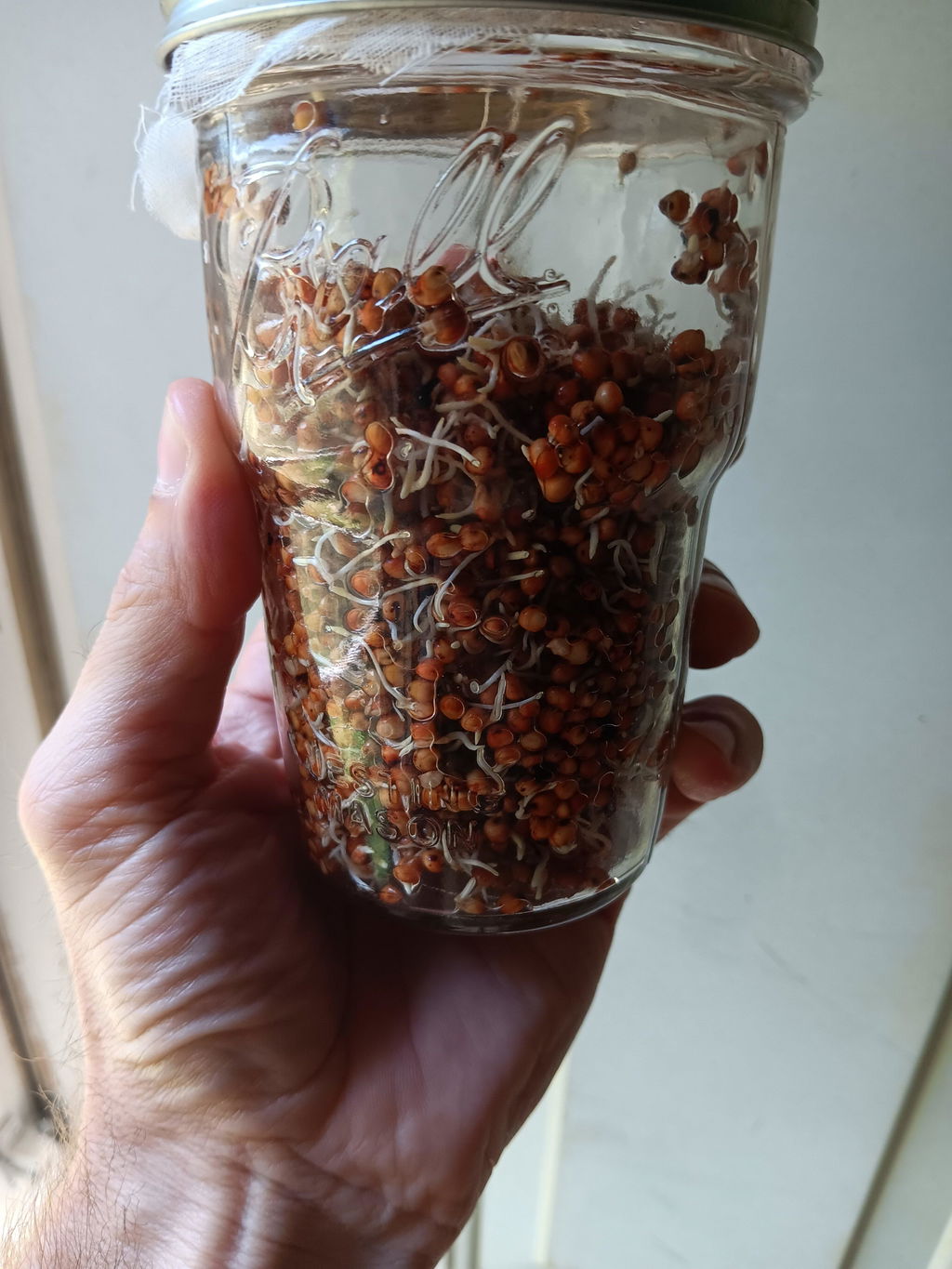
Bulk Red Sorghum (Milo) Grain
Bulk Red Sorghum (Milo) Grain - 40 Pounds is backordered and will ship as soon as it is back in stock.
Couldn't load pickup availability

Description
Description
Bulk Red Sorghum (Milo) is triple-cleaned red milo grain for making your own mushroom grain spawn. Sold in 40 lb bags or by the 2,000 lb pallet, with pallet freight included to the lower 48.
Milo’s small kernels create more inoculation points than rye, and its tough hull holds up well under long sterilization cycles. White mycelium stands out against the red hulls, so it’s easy to track colonization.
- 40 lbsPer bag
- 2,000 lbsPer pallet
- TripleCleaned
- USAGrown
- Free freightPallets, lower 48
Why growers use red sorghum (milo)
- More inoculation points – Small kernels spread mycelium through the jar or bag from more starting points.
- Holds up to sterilization – A tough outer hull keeps kernels intact through long pressure-cooker cycles.
- Easy to track – White mycelium contrasts with the red hulls, so you can see colonization progress.
- Triple-cleaned – Less debris for smoother hydration and sterilization.
- Cost-effective – An economical base for high-volume spawn production.
What you get
- 40 lb bag of dry red sorghum (milo), or
- Pallet: 2,000 lbs, freight included to the lower 48 United States
How to make milo grain spawn
The short versionRinse, hydrate, dry the surface, then pressure-sterilize. Grain spawn must be sterilized, not just pasteurized.
- Rinse. Rinse the milo until the water runs mostly clear.
- Soak and simmer. Soak overnight, then simmer for 15–20 minutes, stopping before the kernels split.
- Dry the surface. Drain and spread the grain on a clean surface until the outside of each kernel looks dry. A kernel pressed between your fingers should give slightly without releasing water.
- Fill jars or bags. Load filter-patch spawn bags or grain jars, keeping filters clear of wet grain.
- Sterilize at 15 PSI. Quart jars and 1–3 lb bags: 2.5 hours. Larger or denser loads: up to 3–3.5 hours. Start timing once the load is actually at temperature.
- Cool, then inoculate. Let jars or bags cool fully, ideally 12–24 hours, then inoculate with sterile technique. Most gourmet species colonize best at 75–82°F.
Want the full walkthrough? Our grain and grain spawn guide covers grain choice, hydration, sterilization and spawn rates.
Compare our bulk grains
| Grain | Kernel size | Color | 40 lb bag | 2,000 lb pallet |
|---|---|---|---|---|
| Organic rye berries | Large | Tan | Yes | Yes, freight included |
| White millet | Very small | Pale | Yes | Yes, freight included |
| Red millet | Very small | Red | Yes | — |
| White sorghum (milo) | Small | Light | Yes | Yes, freight included |
| Red sorghum (milo) | Small | Red | Yes | Yes, freight included |
Specifications
| Specification | Detail |
|---|---|
| Grain | Red sorghum (milo), dry |
| Cleaning | Triple-cleaned |
| Source | USA farms |
| Bag size | 40 lbs |
| Pallet | 2,000 lbs, freight included to the lower 48 |
| Sterilization | 15 PSI, 2.5 hours for quart jars and 1–3 lb bags; up to 3–3.5 hours for larger loads |
| Uses | Grain spawn jars, spawn bags, grain-to-grain transfers, spawning to bulk |
Skip the prepDon’t want to cook grain? Our sterilized 5-grain spawn bags — milo, millet, rye and more — come hydrated, sterilized and ready to inoculate.
FAQ
Is milo the same as sorghum?
Yes. Milo is grain sorghum. Red milo has a red hull; white milo has a light one.
Why use milo for grain spawn?
Its small kernels give more inoculation points than rye, its tough hull holds up through sterilization, and it’s economical for high-volume spawn. For some species it colonizes a little slower than rye.
How long do I sterilize it?
At 15 PSI, quart jars and 1–3 lb bags need about 2.5 hours. Larger or denser loads can need 3–3.5 hours. Start timing once the load is actually at temperature, not when the gauge first reads 15 PSI.
How do I avoid bacterial contamination?
Don’t over-hydrate. Stop simmering before kernels split and let the surface dry before you fill jars or bags — over-wet grain is the most common cause of sour, bacterial spawn.
How does pallet shipping work?
A pallet is 2,000 lbs, and pallet pricing includes freight to the lower 48 United States.