


 $1.00 off
 $2.00 off
-



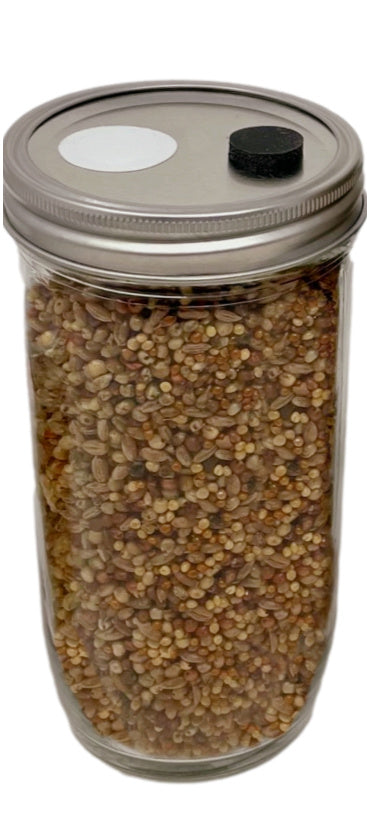

Choosing the Right Grain Spawn Jar
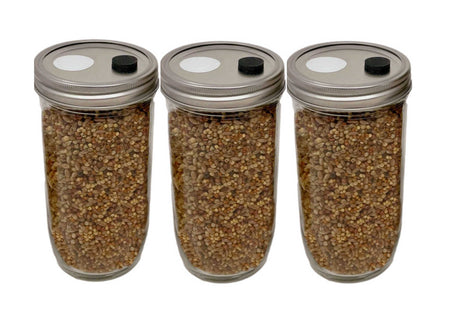
Two decisions to make: which grain and which size. All four jars use the same sterilization spec, the same self-healing injection port, and the same 0.22 micron filter. The differences come down to grain choice and jar design. Here is how to pick.
Grain choice: 5-Grain or Organic Rye?
Premium 5-Grain (Top Seller)
A blend of rye berries, white milo, red milo, white millet, and red millet. The mix of grain sizes creates significantly more surface area than any single grain, which means mycelium colonizes faster. Made with organic grains (the millet is certified organic; milo is not certified organic but is conventionally grown without GMO seeds).
Easier to break apart and mix into bulk substrate than pure rye. What most monotub growers run as their daily driver.
USDA Certified Organic Rye Berry
100 percent USDA certified organic rye berries. Single-grain, dense, nutritious, and the classic mushroom standard for decades. Takes slightly longer to colonize than the 5-grain blend due to larger grain size and less total surface area, but many experienced growers prefer the consistency and tradition of pure rye, and the organic certification matters for some growers selling fruiting bodies commercially.
Jar size: 32oz or 24oz?
32oz Standard (Top-Selling Size)
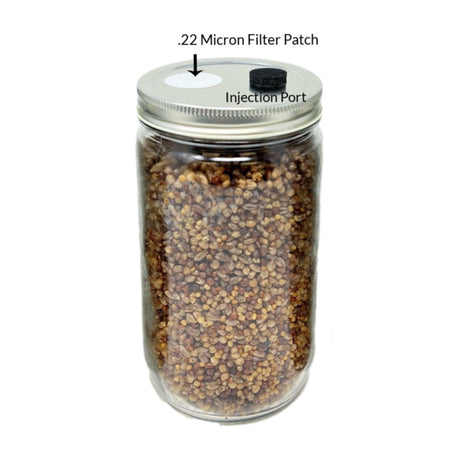
Standard wide-mouth quart mason jar with our custom self-healing injection lid. The most popular size, recommended for the majority of monotub builds. Each 32oz jar holds enough colonized grain to spawn a 28Q small monotub.
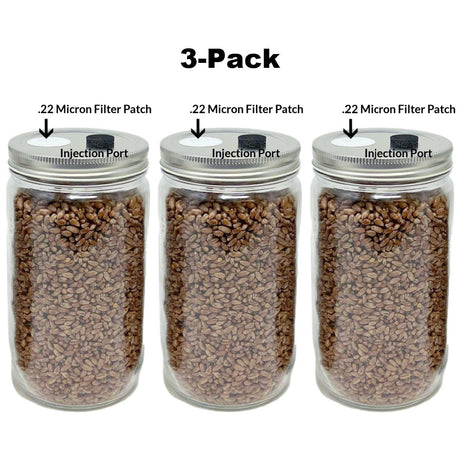
Available in both 5-Grain and Organic Rye, in single jars and 3-packs.
24oz Super-Quick-Colonizing (Tapered Design)
Our custom-made tapered-neck jars, available only at Midwest Grow Kits. The shape gives you two real advantages over standard jars:
- Faster colonization. The narrower profile means less grain depth, which allows mycelium to colonize from top to bottom faster.
- Easier spawn-out. The tapered neck lets the fully colonized grain slide right out of the jar in one piece. No banging, no scraping, no breaking the colonized mass apart inside the jar.
Available in 5-Grain only, in single jars and 3-packs.
Single 24oz Tapered 5-Grain Jar | 3-Pack 24oz Tapered 5-Grain
How many jars do I need for my monotub?
For 32oz jars (our standard recommendation):
- 28Q small monotub: 1 jar (32oz)
- 44Q medium monotub: 2 jars (32oz)
- 66Q large monotub: 3 jars (32oz)
This is why our 3-packs exist: they save you money per jar and give you exactly enough spawn for a 66Q tub (or three 28Q tubs, if you prefer to run multiple smaller grows).
How to use a grain spawn jar, start to finish
For the complete walkthrough with photos, see our Spawn Bag & Grain Jar Inoculation, Incubation & Colonization Guide. The short version:
Step 1: Inoculation
- Shake your liquid culture syringe to evenly distribute mycelium.
- Flame-sterilize the needle until red-hot, then let it cool for 10 to 15 seconds.
- Wipe the self-healing injection port on the lid with 70 percent isopropyl alcohol.
- Inject 1 to 2cc of liquid culture per jar through the port.
- Cover the port with a piece of micropore tape (optional but recommended).
Step 2: Incubation
- Store the jar at 70 to 75 degrees Fahrenheit out of direct light. A closet, cabinet, or dedicated incubator works.
- Check daily for the first signs of growth (small white fuzzy patches near the injection site, typically within 5 to 10 days).
- Once mycelium has covered roughly 30 to 50 percent of the jar, give it a gentle shake to break up the colonized clumps and distribute the mycelium throughout the uncolonized grain.
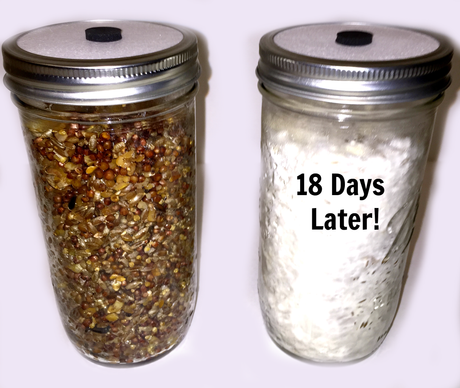
- Full colonization typically completes 14 to 21 days after inoculation. The 24oz tapered jars often finish on the faster end of that range.
Step 3: Spawning to bulk substrate
- Wipe down your work area with 70 percent isopropyl alcohol.
- Open the jar (for tapered 24oz jars, the colonized grain slides out as one piece; for 32oz jars, you may need to gently break the mass loose).
- Break the colonized grain back into loose pieces.
- Mix into bulk substrate in your monotub at the recommended ratio for your tub size.
- Start the fruiting cycle.
Jar specifications
- Glass: Wide-mouth mason jar (32oz standard, 24oz custom-tapered)
- Lid: Self-healing injection port for syringe inoculation
- Filter: 0.22 micron filter for gas exchange and contamination protection
- Sterilization: Pressure-sterilized in our autoclaves for 3 full hours
- Grain: 5-Grain (made with organic grains) or USDA Certified Organic Rye
- Production: Made fresh daily, in-house at Midwest Grow Kits
- Shelf life: Best within 90 days, up to 120 days refrigerated
Frequently Asked Questions About Grain Spawn Jars
What is the difference between the 32oz and 24oz jars?
The 32oz is our standard wide-mouth quart jar and our top-selling size. The 24oz jars are our custom-made tapered-neck design, available only at Midwest Grow Kits. The taper has two advantages: the narrower profile lets mycelium colonize faster (top to bottom), and the colonized grain slides out of the jar in one piece when you spawn to bulk. The 24oz is sold only in our 5-Grain formulation.
How many jars do I need for my monotub?
For 32oz jars: 1 jar spawns a 28Q small monotub, 2 jars spawn a 44Q medium, and 3 jars spawn a 66Q large. The 3-pack exists specifically because a 66Q tub needs three jars, and the pack saves money per jar versus buying three singles.
What is the difference between the 5-Grain and Organic Rye?
The Premium 5-Grain blends rye berries with milo and millet to increase surface area, which speeds up colonization and makes the colonized grain easier to break apart for mixing into bulk substrate. The 5-Grain is made with organic grains (organic millet, conventionally grown non-GMO milo). The Organic Rye Berry option is 100 percent USDA certified organic rye, single-grain, and matters for growers who need the organic certification for commercial sale of their fruiting bodies.
How long do grain spawn jars take to colonize?
Typical colonization is 14 to 21 days at room temperature (70 to 75 degrees Fahrenheit) when inoculated with a quality liquid culture syringe. Spore syringes take longer, often 21 to 35 days. The 24oz tapered jars often colonize on the faster end of the range due to the narrower profile. For a full timeline walkthrough, see our Spawn Bag & Grain Jar Inoculation Guide.
How much liquid culture should I inject into a jar?
Inject 1 to 2cc of liquid culture per jar through the self-healing port. More is not better. Over-injection wastes culture and can introduce more potential contamination from the syringe itself.
Why are your 24oz jars custom-shaped?
We have the 24oz jars custom-made with a tapered neck, which solves two problems with standard wide-mouth jars. First, the narrower profile means less grain depth, which lets mycelium colonize top-to-bottom faster. Second, the taper lets the fully colonized grain slide out of the jar in one solid piece when you spawn to bulk. No banging the jar on the counter, no scraping with a sterilized tool, no breaking the colonized mass apart inside the jar.
How long do grain spawn jars last?
Our jars work best when used within 90 days of production. Refrigerated, they can last up to 120 days. We make jars fresh daily and ship the freshest stock first.
Can I reuse the glass jars after spawning?
Yes. The mason jars themselves are reusable indefinitely. The self-healing injection lid is also reusable for several cycles before the silicone wears out from repeated needle punctures. Many growers reuse our jars for their own home-sterilized grain spawn after the first cycle.
Why are your grain jars sterilized for 3 hours?
Most DIY home sterilization runs 90 minutes or less, which kills active microbes but does not reliably kill endospores (the dormant, heat-resistant forms produced by some contaminant bacteria). Three hours at full pressure in our autoclaves kills endospores too, which is why our jars have a dramatically lower contamination rate than typical home-sterilized grain.
What grain is best for mushroom cultivation in jars?
Different grains have different strengths. The 5-Grain blend colonizes faster and breaks apart more easily for bulk spawning, which is why most monotub growers prefer it. Pure rye is the classic single-grain standard, preferred by some growers for tradition and consistency, and required for anyone who needs USDA Organic certification on their fruiting bodies.
Do I need a flow hood to inoculate a grain jar?
No. The self-healing injection port is designed for sanitary inoculation in a normal room with basic technique: alcohol on the port, flame-sterilized needle, clean hands. A flow hood or still air box reduces contamination risk further and is required for any work that involves opening the jar (such as grain-to-grain transfers), but it is not needed for initial injection.
What is the difference between these jars and the BRF / PF Tek jars?
Our grain spawn jars are 32oz and 24oz larger jars used for bulk monotub spawning. The smaller half-pint BRF / PF Tek jars are designed for the classic PF Tek (brown rice flour) growing method, where you grow and fruit mushrooms directly off the small jar's substrate cake. Different jars, different cultivation methods.