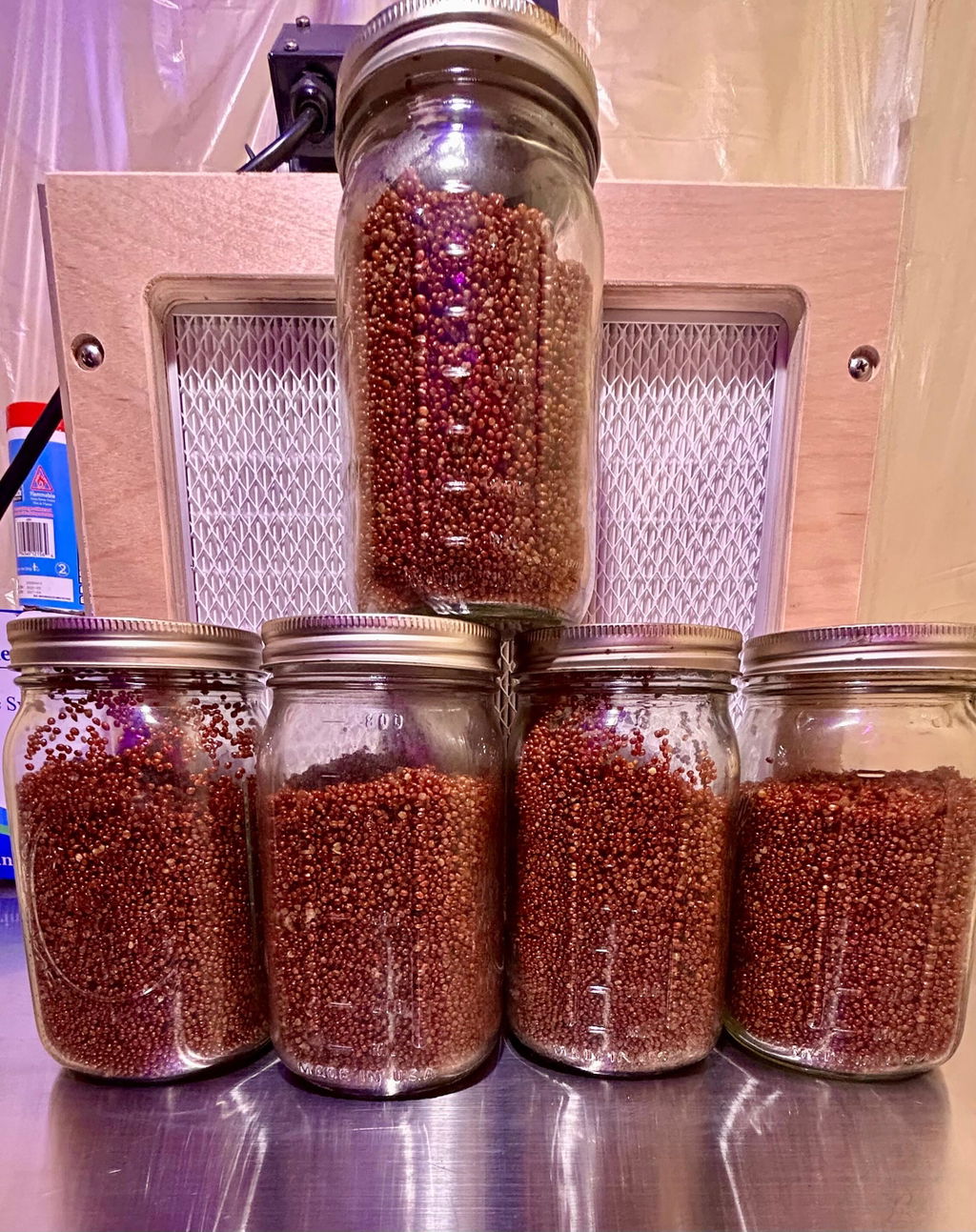
Bulk Red Millet Grain
Bulk Red Millet Grain is backordered and will ship as soon as it is back in stock.
Couldn't load pickup availability

Description
Description
Bulk Red Millet is dry, untreated red proso millet for making your own mushroom grain spawn. Sold in 40 lb bags.
Like white millet, red millet’s small kernels give mycelium far more inoculation points per jar or bag than larger grains, for fast, even colonization. It’s sourced from Midwest farms that use sustainable practices.
- 40 lbsPer bag
- RedProso millet
- UntreatedDry grain
- SmallKernels
- MidwestFarm-sourced
Why growers use red millet
- More inoculation points – Small kernels mean many more colonization points per jar or bag than rye.
- Even spawn – Colonized millet breaks apart into fine, evenly distributed spawn.
- Low endospore load – Helps cut contamination risk during colonization.
- Nutrient-dense – Naturally high in protein and fiber to feed healthy mycelium.
- Midwest-sourced – Grown by local Midwest farms using sustainable practices.
What you get
- 40 lb bag of dry red millet
How to make millet grain spawn
The short versionRinse, hydrate, dry the surface, then pressure-sterilize. Grain spawn must be sterilized, not just pasteurized.
- Rinse. Rinse the millet until the water runs mostly clear.
- Soak and simmer. Soak overnight, then simmer briefly. Millet’s small kernels hydrate fast, so check often and stop before they split — overcooked millet turns to paste.
- Dry the surface. Drain and spread the grain on a clean surface until the outside of each kernel looks dry. A kernel pressed between your fingers should give slightly without releasing water.
- Fill jars or bags. Load filter-patch spawn bags or grain jars, keeping filters clear of wet grain.
- Sterilize at 15 PSI. Quart jars and 1–3 lb bags: 2.5 hours. Larger or denser loads: up to 3–3.5 hours. Start timing once the load is actually at temperature.
- Cool, then inoculate. Let jars or bags cool fully, ideally 12–24 hours, then inoculate with sterile technique. Most gourmet species colonize best at 75–82°F.
Want the full walkthrough? Our grain and grain spawn guide covers grain choice, hydration, sterilization and spawn rates.
Compare our bulk grains
| Grain | Kernel size | Color | 40 lb bag | 2,000 lb pallet |
|---|---|---|---|---|
| Organic rye berries | Large | Tan | Yes | Yes, freight included |
| White millet | Very small | Pale | Yes | Yes, freight included |
| Red millet | Very small | Red | Yes | — |
| White sorghum (milo) | Small | Light | Yes | Yes, freight included |
| Red sorghum (milo) | Small | Red | Yes | Yes, freight included |
Specifications
| Specification | Detail |
|---|---|
| Grain | Red proso millet, dry and untreated |
| Bag size | 40 lbs |
| Source | Midwest farms, sustainably grown |
| Sterilization | 15 PSI, 2.5 hours for quart jars and 1–3 lb bags; up to 3–3.5 hours for larger loads |
| Uses | Grain spawn jars, spawn bags, grain-to-grain transfers, spawning to bulk |
Skip the prepDon’t want to cook grain? Our sterilized 5-grain spawn bags — milo, millet, rye and more — come hydrated, sterilized and ready to inoculate.
FAQ
What is red millet?
Red proso millet — a small-kerneled millet with a red hull. For spawn it behaves much like white millet, giving you many inoculation points per jar or bag.
Do you sell red millet by the pallet?
Red millet is sold in 40 lb bags. For pallet quantities, see white millet or our sorghum (milo) pallets.
How long do I sterilize it?
At 15 PSI, quart jars and 1–3 lb bags need about 2.5 hours. Larger or denser loads can need 3–3.5 hours. Start timing once the load is actually at temperature, not when the gauge first reads 15 PSI.
How do I avoid bacterial contamination?
Don’t over-hydrate. Stop simmering before kernels split and let the surface dry before you fill jars or bags — over-wet grain is the most common cause of sour, bacterial spawn.